
Fix It
2004
Installation
Mixed media installation
Factory fixtures and furnishings, light bulbs, programmable lighting equipment, electric cable, amplifier, mixer, 2 speakers
Variable dimensions
Loan from the Ministry of Culture to the Collection of the National Museum of Contemporary Art, Athens (ΕΜΣΤ), 2004
Inv. No. 533/04
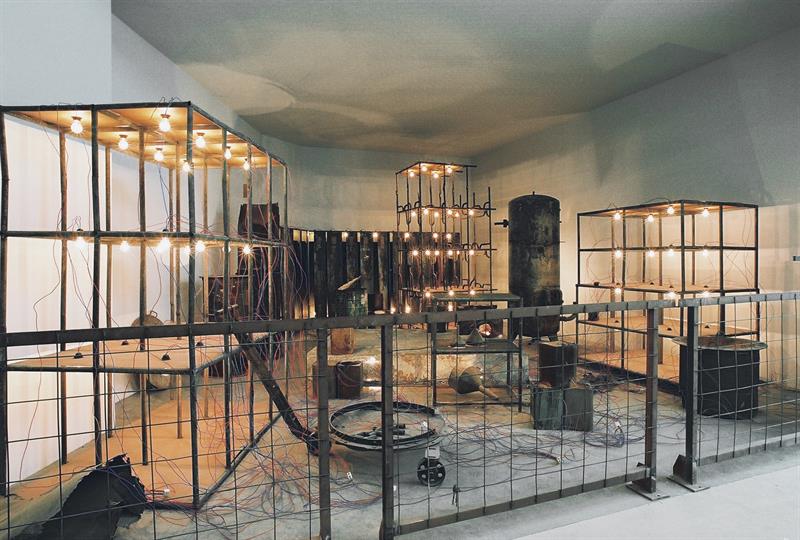
Hatoum’s work occupies a prominent place within the ΕΜΣΤ Collection, as it engages directly with the archaeology of the industrial site, and by extension with the identity of the museum itself. In this in situ installation, titled Fix It and commissioned by the museum in 2004 as part of its Transcultures exhibition, the artist salvaged old, rusty fixtures and other objects from the abandoned former Fix brewery before reconstruction work began on ΕΜΣΤ’s permanent home. In an attempt to preserve the memory of the decaying urban industrial landscape that had once served as an Athens landmark, Hatoum — who is of Palestinian origin –used metal mesh barriers found on the premises to create an enclosed space measuring 6×10 meters. Within it, she placed rusted industrial components, containers, boilers, shelves and cabinets, as well as other materials salvaged from the abandoned building. Throughout the installation, electric light bulbs intermittently fade up and down or flicker, producing corresponding buzzing and crackling sounds that trigger both surprise and an unsettling sense of anxiety, rooted in the claustrophobic atmosphere of malfunction. The installation becomes a metaphor for what has passed, flickering intermittently in memory as time goes by.
Hatoum was among the first artists from the broader Middle Eastern region to have her work included in the museum Collection. Through her art, she conveys memories and lived experiences that are often inextricably linked to her background of war, exile and the cultural contradictions between East and West. She explores the phenomenology of space and materials, as well as issues related to systems of control within the social fabric, displacement and disorientation. Since the late 1980s, she has used simple materials, light and sound to create ambiguous architectural spaces. Within these spaces she employs multiple opposing elements—light and darkness, decay and regeneration, order and disorder, movement and stillness—to challenge expectations and generate contradictory emotions in the viewer, prompting open-ended interpretations.