
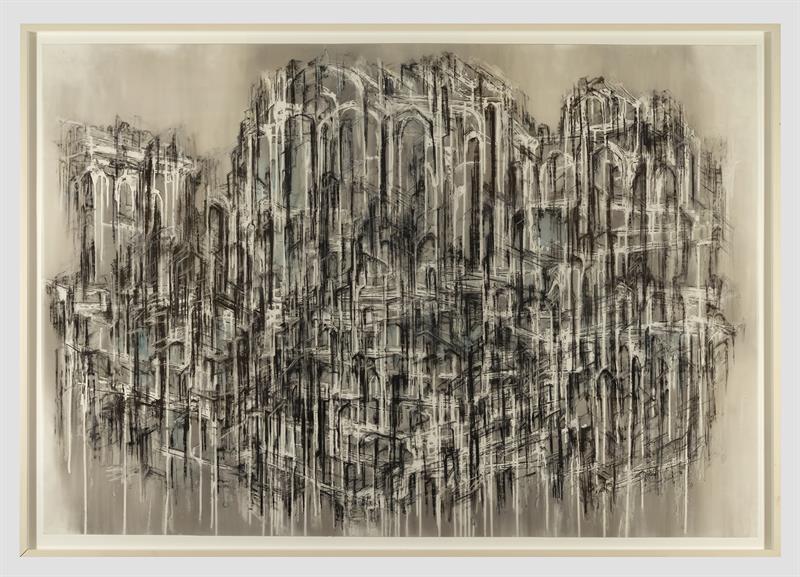
Untitled
2011
Painting
Xerox transfer, charcoal, conte and watercolor on vellum
104 × 152 cm
Presented as part of the D.Daskalopoulos Collection Gift
Inv. No. 1584/25
Deploying an artistic practice that spans sculpture, wall reliefs, and works on paper equally, Diana Al-Hadid (1981, Aleppo, Syria) forges enigmatic narratives that draw inspiration both from ancient and contemporary civilizations. Her works often mirror the majestic and imposing aesthetics of ancient ruins while at the same time appearing precarious and on the eve of collapse. This illusion of instability lies in contrast to the seemingly solid structure of her ornate sculptural installations. Through these installations, Al-Hadid explores previous and contemporary notions around architecture, science, space and time. Her visual work encompasses a wide range of influences, including eastern and western ancient mythologies and narratives, gothic architecture, western painting, arabic traditions, islamic civilization, physics, and astronomy. Her creations often recall baroque architectural forms that are, however, in a state of dissolution.
The drawing Untitled (2011) refers to the large-scale installation Water Thief (2010), a monumental sculpture, also in the collection of ΕΜΣΤ, inspired by the well-known water clock invented in 1206 by the distinguished mechanic Al-Jazari, who lived in northeastern Syria. Water clocks are the oldest time-measuring instruments and have been used since antiquity to measure the passage of time by means of the flow of water. They were called “hourglasses” or “water thieves”” – from which the artist drew the title of her work. Water Thief resembles the ruin of an ancient mechanical device, and the water appears to be flowing and pouring into its fragments.
Diana Al-Hadid was born in Aleppo, Syria, in 1981. Today, she lives and works in New York. She has held solo exhibitions in various institutions and museums (selection): Frist Art Museum, Nashville (2019); The Bronx Museum of the Arts, New York (2018); San Jose Museum of Art, California (2017); Vienna Secession, Austria (2014); Akron Museum of Art, Cleveland, Ohio (2013); Weatherspoon Museum of Art, Greensboro, North Carolina (2013); Virginia Museum of Fine Arts, Richmond, Virginia (2012); Nasher Sculpture Center, Dallas, Texas (2011); Centro de Arte Contemporáneo La Conservera, Murcia, Spain (2011); Nevada Museum of Art, Reno, Nevada (2011); and Hammer Museum, Los Angeles (2010).